
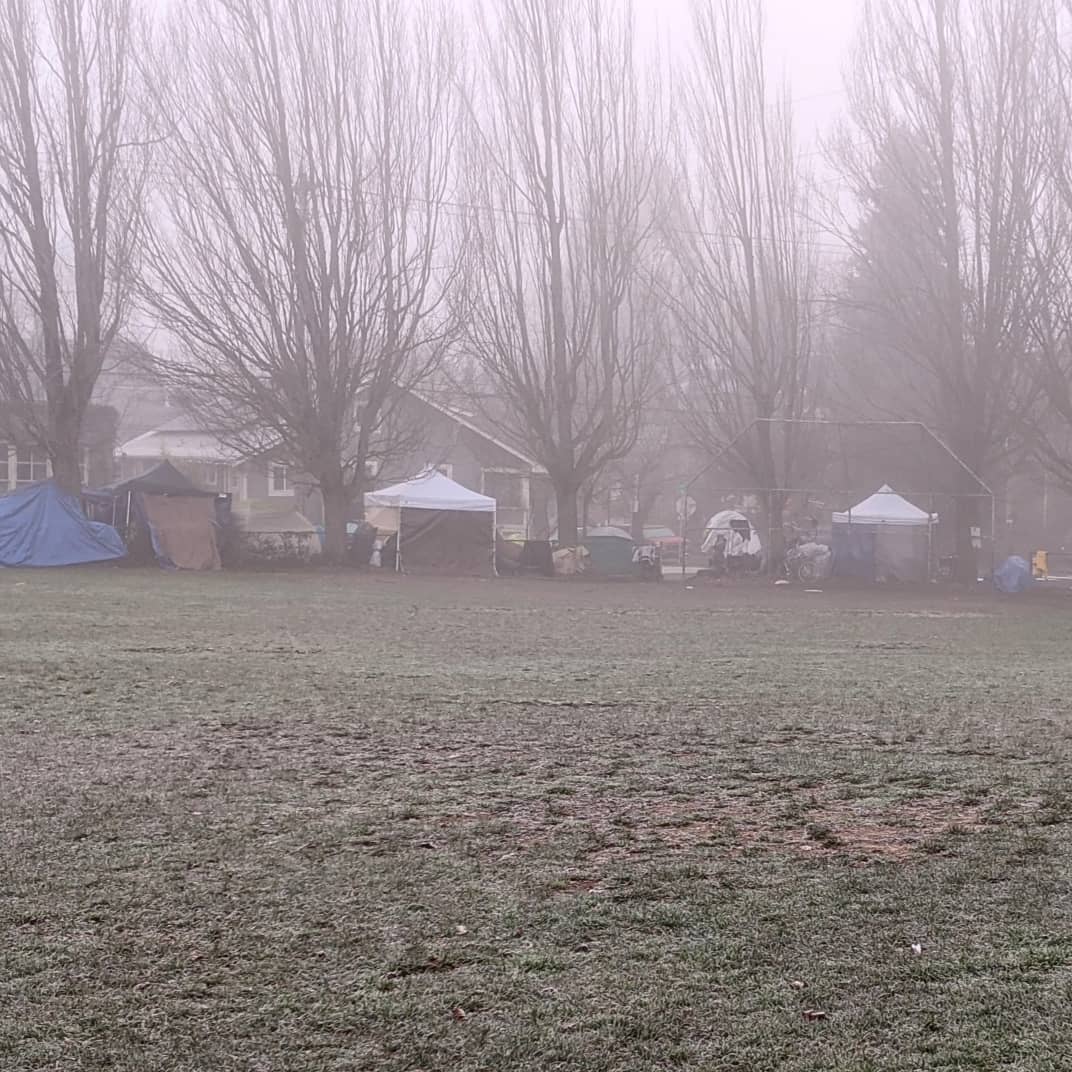
Update on Sunnyside Encampment

We as a neighborhood association have been wrestling with the houseless crisis in our neighborhood more urgently since the camp at Sunnyside Environmental School has gone up over the past few weeks. We realize and fully understand that the location of this camp is not ideal for a variety of reasons, not the least of which is that this is an elementary school with one of the few playgrounds in our neighborhood.  While we, the City and other agencies look for another place for these campers to live, we are working hard to make sure that these folks have food, access to bathrooms, trash pickup, and other services.

In December 2020, the Sunnyside Neighborhood Association endorsed the “Community First” Strategy to help guide us in our response to homelessness. This strategy guides us in our current response to the camp at Sunnyside Environmental School: 

  • We believe that unsupported camps are neither compassionate nor best practice. We are actively looking for potential alternative spaces/land for these houseless campers where they could set up a more permanent camp like Dignity Village or Agape Village.  
  • We believe that as a host community, we have a vital role to play, while it is also reasonable for us to have expectations as well. We realize that acceptable camp spaces do not include parks and school grounds.
  • As we look for alternative camping locations, we believe compassion comes first. Our Community Safety & Livability Committee has been engaging in rigorous on-the-ground efforts aimed at mitigating the impact of unsupported camping conditions for both unhoused and housed neighbors alike. We’re working very closely with government agencies (the City’s Homelessness and Urban Camping Impact Reduction Program, Metro, and Portland Police Bureau specifically) to gain access to additional resources and ensure leaders at these levels are informed. 

Here’s a more detailed update of what’s happened since our Dec. 28 Community Safety & Livability Committee meeting. 

First, several of our committee members made contact with Katie Lindsay from the Homelessness and Urban Camping Impact Reduction Program (HUCIRP). Lindsay walked around the encampment on Tuesday Dec. 29 and was told about the neighborhood’s concerns about drug use, potential crime, trash, and loud noises after hours. We also told her of the camp’s need for a port-a-potty and asked that it be placed away from the playground (and away from neighbors’ houses) on the North side of Yamhill. Later on Tuesday, Lindsay let us know that the area along 34th street would be “posted”—i.e. that signs would go up alerting folks that it would be cleared and cleaned on Monday, January 4.

Those signs went up on Wednesday Dec. 30. Members of Rapid Response (the clean-up service the City employs) and volunteers from our committee are working to help those people camped along 34th relocate elsewhere in the city. (Emergency shelters are also a possibility but as those are for just one night only, don’t allow any personal belongings, and don’t have any private rooms, they are usually a non-starter for most campers.)

A port-a-potty was set up on the corner of 34th and Yamhill on Wednesday as well.

While neighborhood volunteers started doing cleanups and trash pickups as early as last week, Metro began doing daily trash collection at the park as of Wednesday Dec. 30. Volunteers have been handing out Metro trash bags to campers, who know to leave the full bags at the corner of 35th and Yamhill for pick-up.

The needle box on 35th (near Yamhill) is back in service. We are working on getting the needle box on 34th (across from Taylor) back in service as well. Volunteers are monitoring and emptying those boxes at the main needle drop over at the Belmont Library.

If you have any interest in volunteering to help with trash pick-up, outreach, or an upcoming clothing drive please contact Jes Maran at csl at sunnysideportland.org .
Community Safety & Livability Monday December 28, 2020 6:30 PM

Community Safety & Livability
Monday, December 28⋅6:30 – 7:30pm

Agenda:

  • Follow up on outreach meeting with SES Park camp residents
  • Discovery of areas for potential sanctioned camps
  • Coordinate winter gear drive
  • Clarify Community Safety & Livability Meeting Time

https://us02web.zoom.us/j/83684915370?pwd=NWVhdmRDNEh2R1ptK3FVL0FEKzdkdz09

Meeting ID: 836 8491 5370 Passcode: 128522

One tap mobile +12532158782,,83684915370#,,,,,,0#,,128522# US (Tacoma)

Dial by your location +1 253 215 8782 US (Tacoma)

Meeting ID: 836 8491 5370
Passcode: 128522

Land Use and Transportation in Sunnyside and Beyond!

4738 SE Belmont St. Update. Following their presentation at the October 8th SNA meeting, the architect of the proposed multi-family development at 4738 SE Belmont provide notes with responses to the attendees’ questions.  A selection of comments and the Architect’s responses follows:

 The fence along the perimeter of the site appears a bit industrial in design. We will take a closer look at designs to make this fence more residential in nature and to provide plantings at the fence along 48th. These plantings will also assist in screening the rear of the building from the street.

There is concern about the height relationship and visual screening between this structure and the single-family home to the south. We have offered to work with the resident of this home to design the landscaping buffer to best suite them.

How will the existing building be disposed during demolition? There are currently no plans to take special actions to divert from landfills. All demolition and disposal of building materials will be in accordance with state, federal and local codes.

Will an elevator be provided? An elevator is not proposed for this development.

There is concern about bike security on the site given bicycle theft is an issue in the area. All bike parking will be located within locked gates or within the building in a bicycle parking room. Since this discussion, we have also added a video monitoring system that will cover all parked bicycles.

Incorporating two- and three-bedroom units would be welcome in the project, particularly to promote tenant retention in the neighborhood as families grow and require more space. This is an excellent point; however, the unit mix will remain as studios and one-bedrooms for this project.

SNA Safety & Livability Update

At the November SNA meeting we discussed the ongoing crisis on Oak Street by Laurelhurst Park, deciding that we need to ask the city what their plans are for services to the camp. At this point there is a discussion of a sweep rather than an effort to provide assistance and sanitation. While the City claims there is a public health issue with the manner in which people are living, the CDC is crystal clear on not moving people regardless of ability to social distance. The City secondarily claims a “verified nexus of criminal activity.”

We proposed getting a written commitment from the City of their intention to do a deep clean, allowing people to return. The City has been doing that throughout COVID19. We believe that the City’s messaging isn’t successful enough in making it clear how these sweeps benefit the houseless campers in Laurelhurst Park.

My personal perspective is that if there’s criminal activity, then the Portland police should do law enforcement and leave the rest of the camp alone. The logic behind the “sweep because crime” narrative baffles me. Using this logic, if I went on a crime spree the city, in the form of its various agencies, would show up, and rather than arrest me they would evict not only me but all my neighbors and bulldoze our building. The loss of human life is unacceptable and the enormous expense has to outweigh the cost of law enforcement. If this is because of the “catch and release” program alleged to be happening at the County level, then we need to start addressing that.

We discussed the existence of disconnected “information silos” being an issue between city agencies, NAs, residents, activists, and service providers. A motion was unanimously approved for the following action items:

  • Liaise with the Laurelhurst Neighborhood Association to understand their plan of action and feelings, and
  • Reach out to the City to ask for a mediator to begin a conversation with campers and surrounding neighbors

We welcomed Vahid Brown, a founder of Agape Village (https://www.agapevillagepdx.org/) and Hazelnut Grove, whose expertise and experience with managed service providers and shelters is invaluable. We continued discussing various possibilities including sanctioned tent camps, parking spaces for community members who are vehicle camping, more permanent structures such as tiny houses, and services. Vahid noted that there was a statement released by the Village Coalition (https://www.pdxvillagecoalition.org/) underscoring the harmfulness of sweeps.

We are working to have the Sunnyside Methodist Church Emergency Warming Shelter available for freezing nights, and we discussed how to get an inspection. The church can provide 10 beds and has lists of potential volunteers. For a properly managed service, the shelter would need two volunteers per shift; there would be two to three shifts of four to six hours each. Emergency shelters usually operate from 6 p.m. to 6 a.m.

At our November 17th Safety and Livability meeting we welcomed a member of HUCIRP (Homelessness/Urban Camping Impact Reduction Program) to get some answers and learn what policies are in effect during the COVID19 pandemic.

Getting to Know Your Neighbors

Q&A with Vahid Brown

As one of the founders of Hazelnut Grove, the houseless village at N. Interstate and N. Greeley, Vahid Brown knows a thing or two about advocating for Portland’s houseless population. For the past five years, he has worked as the Housing Policy Coordinator for Clackamas County’s Department of Health, Housing & Human Services. Recently, he has transitioned into a role leading the Clackamas implementation team for funds raised by Metro Measure 26-210. The measure, which passed by a sizable margin in May, is expected to raise $250 million a year for homeless services in Clackamas, Multnomah, and Washington counties. “It’s the largest per capita investment in homeless services the U.S. has ever seen,” Brown says.

How long have you lived in Sunnyside? Since the beginning of the year. I was in Raleigh Hills before this and I did not like living in outer Southwest. There were no sidewalks where I lived! No coffee shops! If my partner and I wanted to eat a vegan brunch, we’d come to Southeast.

Do you rent or own? Rent. I have a friend who told me the other side of the duplex he lives in was vacating.  

What do you love about Sunnyside—besides the vegan brunches? I love the walkability and the trees. It’s been a balm during COVID to walk so much. 

What’s one thing you would love to see change about Sunnyside?  I’m already seeing it: making the folks experiencing homelessness more welcome and having their needs better served. I was introduced to the Sunnyside Neighborhood Association’s Community Safety & Livability committee recently and I was happy to see they are working on this. 

Many housed Portlanders think that all we need to solve the homeless “problem” are more shelters. Can you explain why this may be shortsighted? While it does make sense to invest in expanding access to shelters, it should be a place where they can be for more than one night and where they can keep their things—a shelter that will allow them to stabilize. While an emergency shelter that’s a night out of the cold is a necessary intervention to save lives, it’s not the be-all-end-all. We also need alternative outdoor shelters and accommodations with community, with friends, and with family. There are some people experiencing homelessness who are seriously traumatized and are choosing their community where they live—people who they trust and feel safe with. They may have a mistrust of government systems and homeless services. A shelter may not seem a safe option to them.

There’s something that we’re missing. If someone gets a long term rental assistance voucher and moves into an apartment, it’s not uncommon that their street community will come over, hang out, use the shower. These are communities. We have to grapple with ways to treat them as communities.