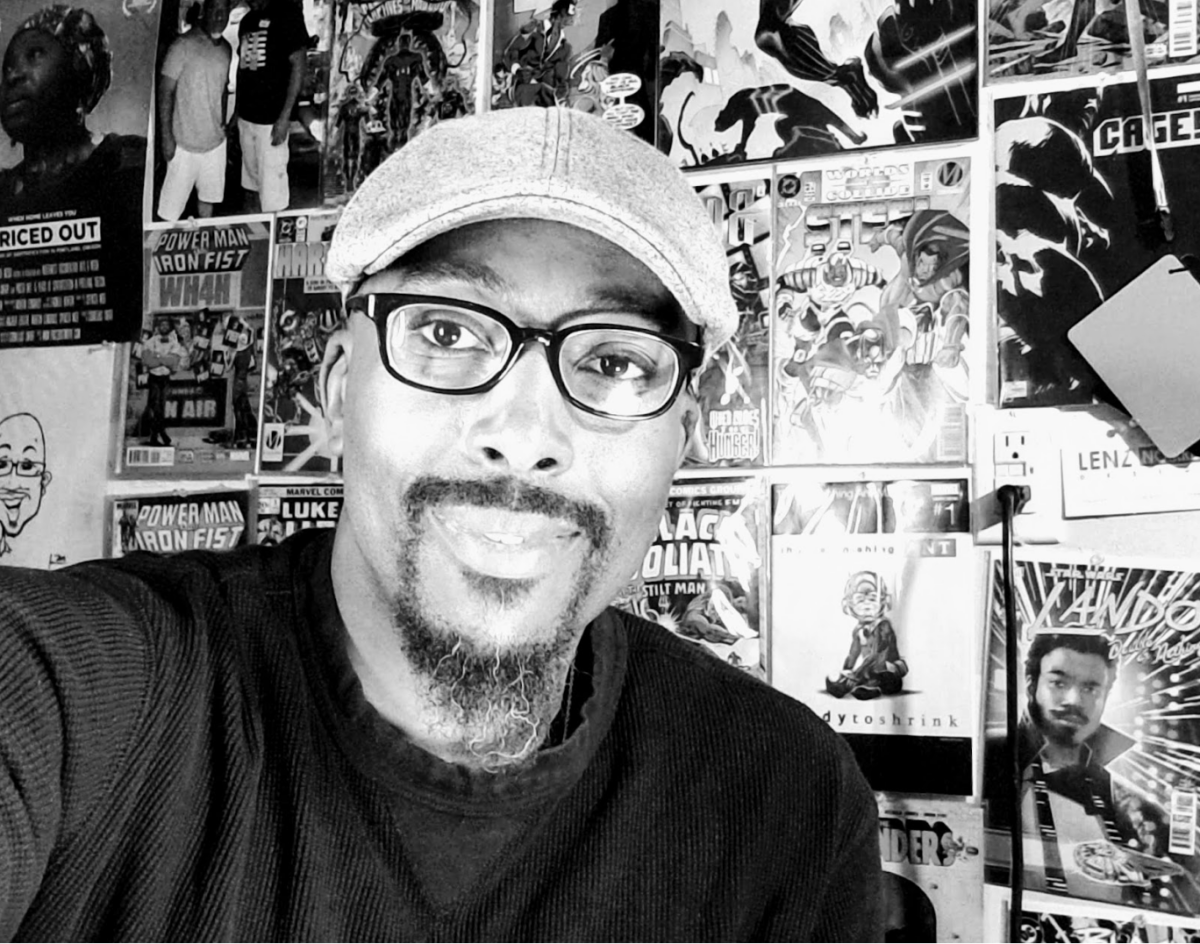
Q&A with Andru Morgan
For the past few years Andru Morgan has been quietly and dedicatedly renovating the basement of the old Sunnyside Methodist Church/The Groves for two nonprofits he’s actively involved with. He and his wife Regina run the Naturally Beautiful Project, a nonprofit that helps children with afro-textured hair be proud of their hair (and helps them and their parents learn how to style it in a way that enhances its natural beauty). Morgan, who is an ordained minister and also a filmmaker, has also set up a community space for NW Documentary at the church that will offer classes on podcasting, film editing, and story-crafting. If you’re a Sunnyside-based filmmaker or creative, you can reach out to Morgan about using the studio as a co-working space. I toured the space with Morgan and talked to him about his past experiences working as a police chaplain and at a homeless shelter in Oklahoma, his work on the award-winning documentary Priced Out, and his first feature film about black comic David F. Walker.
How did you end up here at The Groves?
Andru: When I moved from Oklahoma in 2017, there were several news articles written about me moving here. The pastor of the church then, Sunia, read one of the articles and invited me to hang out. I ended up visiting The Groves and preached a few sermons. We didn’t plan it, but we all got involved with the United Methodist Church at the same time.
At the time, I was at Parkrose United Methodist, where I ran a food pantry and had started my storytelling project. The pandemic interrupted all of that. Ultimately my mother died of Covid, which was a huge blow. So I stepped away from pastoring, allowing me to focus on the Naturally Beautiful Project and the Storytelling Project, leading me to come to Sunnyside to work with The Groves. This place has the potential to bring programming that addresses this community’s social equity.
Why did you move from Oklahoma to Portland?
Andru: I was praying one day and God just said, “It’s time to move.” A few years before, I was on a business trip here and I had brought my wife with me. She was like, “I like it here.” Ironically we were at the Rose Festival and we were like, “It’s so diverse here!” [Laughs.]
What did you do in Tulsa?
Andru: I was a police chaplain. I’d show up to death scenes and contact the family and tell them that their family member has passed on. And I’d sit with them. I also ran an overnight program at a homeless shelter and we also had a drug rehabilitation program. The shelter, called John 3:16, was interdenominational—under the cloak of an “all denominations are welcome” but it was pretty much Southern Baptist. It was an overnight shelter for 200 men—that was the portion I was in charge of. I also worked in the drug rehab program. I was a physical trainer and used to have a marathon running group for the homeless. I was in charge of health and physical wellness, and I would teach life skills.
Tell me about your work on Priced Out. I had no idea you worked on that!
Andru: I was the post-production producer of Priced Out. I met the director, Cornelius Swart, and I also ran events, and hosted screenings. I created a 30-episode podcast for it, which allowed us to screen in Romania and other places around the world. You can now see Priced Out on our YouTube page where there are a few episodes of the podcast.
How much time do you spend on NW Documentary vs. the Naturally Beautiful Project?
Andru: I’m the executive director of the Naturally Beautiful Project, so right now it’s probably 80% on that and the rest on Northwest Documentary.
How many days a week will NW Documentary offer classes in this space?
Andru: It’s usually a few days of the week for the classes, typically for adults. With the Storytelling Project, my nonprofit, we will do a spring break camp for youth. We will also offer summer classes, from animation to editing and other areas of storytelling.
The game plan is to go into each community. Right now we’re in Sunnyside and our offering to Sunnyside is to create this space and maybe in a few years we’ll be able to walk away from this space and give it to Sunnyside. If you were working on your film but you didn’t want to work from home, you could come here, plug into our setup—which includes a high-quality monitor—and put your headphones on, because the basketball [upstairs in the gym] is loud!
How much does it cost to use this space as a co-working space?
Andru: Members of NW Documentary are always invited to come in. If you want to sign up to be a member, just sign up and you are in. Most people donate or they pay for classes. We get a lot of grants, and we try to keep the cost low. We also sponsor documentary film projects and even have an artist-in-residence program that would provide you with additional work space.
Who can take the classes and how much are they?
Andru: The classes are for anyone in the community who signs up on the website. Sam Gaty, who is the executive director, will put the new offerings up soon. Some classes are free, and they’re never at a cost that’s too high. We have to pay instructors, so we need students to pay something for a course, but we’re not looking to make a profit.
Does your documentary have to focus on issues that are important to BIPOC communities?
Andru: It doesn’t have to be. But, we live in Portland and we know it’s important to prioritize them. The fortunate thing about me being in the BIPOC space is that I know how to prioritize us and not let it just be symbolism.
Tell me about NW Documentary and what you do for it?
Andru: NW Documentary has been around for 20 years. Sam Gaty is a visionary and is always on board to help members achieve their own vision. NW Documentary has a long history of collaborating with other community organizations to provide media support. As such it is a crucial sponsor of my Storytelling Project, leading them to set up this location in Sunnyside. Post-pandemic, NW Documentary could have set up in any community, but they see the potential that the Sunnyside community has and chose to partner with the Storytelling Project, and here we are.
Priced Out was made through NW Documentary, and I worked there every day on Priced Out. Then, I started working on my film projects and volunteering for other people’s film projects. Most recently, I started my own film project, UnCaged (the working title), about the life of David F. Walker, the Portland comic book writer.
How is that coming along?
Andru: [Big sigh.] It’s my first full-length feature. Cornelius Swart is my executive producer; the story has taken several turns creatively. We stopped shooting last year, and I’ve been in post-production. I’m going to put up a fundraising trailer in early 2024 as a Kickstarter, just to be able to pay an editor and colorist. We’re hoping that by this time next year, we’ll have a complete project that’s been screened a few times in this community.
What do you like about Sunnyside?
Andru: I think there’s the space and opportunity—the potential. The potential hasn’t become fully potent—but it’s there. You can’t pass up on an opportunity to be a part of something, the rebuilding of something. You know gentrification is going to affect the community in different ways. So to be able to be there and to allow it to be gentrification with justice. We’re not going to stop that beast of capitalism and gentrification but, when you can apply some justice to creating safe spaces for people of color, and safe spaces for people who society calls the “least of these”—that’s our primary mission. Sunnyside as a whole community, in my experience, it seems that potential is there right now.
What do you think needs improvement in Sunnyside?
Andru: I would like to see more community resources spread a little bit further. I love the Shower Project, but I would love another shower group in the neighborhood, to give different options. Even with the lunch [that Beacon PDX offers at the Quaker Meeting House.] Some more services. We can’t ignore the fact that each community in Portland has its own unique homeless population. I would love to be able to say Sunnyside does it with justice, that they do it a little better.
If you’re interested in working at NW Documentary’s space, contact Andru or Sam at [email protected]. In 2024, Andru and Regina’s daughter, Neairra, will be taking over the Vines & Grinds coffee shop in church basement and plans to have it open more than the current three days a week. If you’re interested in renting out the event space for book clubs, poetry readings or other events, contact her at [email protected].
Additional Info:
The Naturally Beautiful Project is a 501c3 that provides natural haircare education for families and individuals looking to enter the natural hair industry. For more information on the services of the project, please check out naturallybeautifulproject.com.