
The SNA is having a quick board meeting on Tues., May 23rd to approve April’s meeting minutes.
Meeting agenda. Times are approximate. Agenda items are subject to change. The meeting will be held online only.
Author: Hannah Wallace
Sunnyside Neighborhood: Getting to Know Your Neighbors
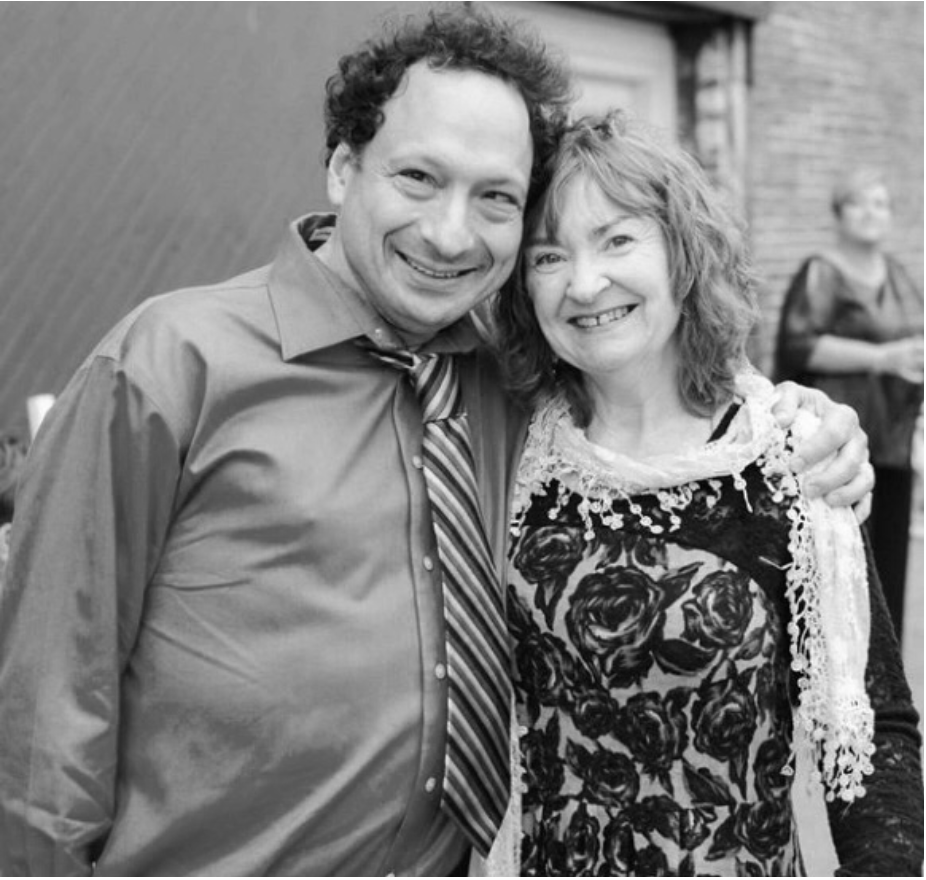
Q&A with Gemma Whelan and Adam Liberman
When Gemma Whelan and Adam Liberman moved to town in 2007 Portland had no Irish theater company to speak of. But Whelan, who is from the Midlands of Ireland, soon discovered that Portlanders had a great appetite for contemporary Irish plays. In 2012, she founded and became the artistic director of Corrib Theatre (corribtheatre.org) and Liberman, a Portland native, became managing director. Though they recently passed the leadership of the theater company on to another couple, Whelan and Liberman remain busy with various pursuits. Whelan has recently published her second novel and Liberman, a technical writer and audio tester, is restoring their 1860s Sunnyside farmhouse.
When did you move to Sunnyside?
Gemma: In 2007 we bought our house. I was working in the Bay Area.
Adam: We had to raise it up in the air and put in a new foundation.
Gemma: Adam is in the process of restoring it to 1903. It’s made out of two early farmhouses.
Adam: Between 1850 and 1870. I’ve collected parts on Ebay, from about 1903. I’ve learned how to do lime-plaster on the kitchen walls.
Gemma: This is not minor. This is major.
Adam: All the infrastructure is going to be modern—we’re not going back to a coal stove! But I’m installing original paneling from 1903. All the light fixtures are from that period. I find them mostly on eBay, but also at Rejuvenation and Hippo Hardware.
To my wife’s dismay, it’s been an ongoing project.
Tell me about Corrib Theatre, which you founded ten years ago.
Gemma: We did this for 10 years. I’ve done theater my whole life—as a director and an educator. I taught at conservatories and theaters. When I moved to Portland, someone asked me about Irish theater. And I said, “Does anybody care about Irish theater in Portland?” It’s not like San Francisco, Boston or NYC, which have big Irish-American populations.
Then in 2012, we did a one man show about Northern Ireland—One Night in November—for an invited audience. It was hugely successful. I thought, “There’s an appetite for Irish theater here.” It was set during the Troubles. People were really interested in the history. So one thing led to another. I was doing small shows at Kells. They gave us the banquet room for free. I started it literally with nothing! Then I learned about grants, structure. We founded a nonprofit and from there it grew. It was a small company—we would do three shows a year. We did a lot of readings, too. We were nomadic—some seasons we performed at a different place for each show.
A new artistic director was hired last June, but I’m directing a show there now called Myra’s Story by Brian Foster, who is from Derry. It’s apropos of this moment. It’s about a woman who is homeless on the streets of Dublin. She’s in her 40s. It’s very funny and also very serious. She’s hilarious —she’s a real character. She ends up telling you the story of her life. It’s set in 2001.
What do you like about Sunnyside?
Gemma: I love Hawthorne. We’re really lucky—we are equidistant between Belmont and Hawthorne. The No. 1 thing I love is that I can walk to Powells and to the Bagdad. Also, I can walk to Buffalo Exchange. The convenience, the walkability. I love that. I cycle most places. I also love Laurelhurst Park.
Adam: I’d say the same thing.
Gemma: Another thing I love about Sunnyside is that I’m a few blocks from the library. That’s sort of a big deal.
What would you like to see change about Sunnyside?
Adam: I always had a dream that the streetcar would be restored to Hawthorne and Belmont. If I were mayor that’s what I would do.
Gemma: I wish there was a YMCA with a swimming pool within walking distance. I used to swim at Buckman Pool and that’s gone. I love swimming and I haven’t done it in years.
Tell me about your new novel, Painting Through the Dark, Gemma.
Gemma: It’s the story of a young Irish woman, a 21-year old, who comes to this country with very few resources. She was training to be a nun in Ireland but left the convent when she found out about suspected sexual abuse by the priest. She’s fleeing her family, as well, who were very restrictive. She arrives in San Francisco. So, it’s how she finds herself being trapped in a menacing household and her art is what helps her to see her way forward.
It’s inspired by some of my own experiences of coming to this country. I actually came to the East Coast. When you write fiction you draw on certain areas of your life. But it’s fiction. I’ve had a reading at Powell’s, one at Broadway Books, and one at Annie Bloom’s.
Dog or Cat?
We don’t have a pet right now but we’re cat people.
Myra’s Story opens on May 5th at 21Ten Theatre at 2110 SE 10th Ave. (formerly the Shoebox Theatre).
You can learn more and buy tickets at corribtheatre.org/myras-story.
Hear Gemma read from her novel at these upcoming readings: Daedalus Books on May 2nd at 7 p.m., May 16th at the Garden Home public library at 6:30 p.m. and on May 21st at 21Ten Theatre at 4 p.m. There is more information on her website gemmawhelan.com.
Sunnyside Neighborhood Community Cares Updates
Instead of our SNACC meeting this month, a few of us from the Sunnyside Shower Project participated in a lively policy conversation on houselessness and public safety sponsored by Portland Forward, an intergenerational organization that envisions a Portland that works for all. Leaders from Street Roots, H4All, and other organizations were present, as were the D.A., a former mayoral candidate, and several singers (one of whom has a singing telegram company). We came up with some big ideas that included increasing pay for social workers, ending the commodification of housing stock, and using Neighborhood Associations as a way to build community amongst unhoused and housed neighbors. Our next SNACC meeting will be on April 20th at 6:30 p.m.
Sunnyside Neighborhood Community Cares (SNACC) Committee Updates
We had a strong turnout at our February meeting, where we discussed the Sunnyside Shower Project’s (SSP) protocols on how to deal with guests who exhibit harmful or dangerous behaviors. Special guest Sandra Comstock, from Hygiene4All, shared some ideas on how they deal with harm to their community. The SSP has a “Code of Conduct” that we hang in our space at the Groves but we have not yet written down a policy for “incident protocols.” We hope to do that in the coming weeks. One helpful tidbit
that Comstock shared is to come at the incident with curiosity. If a person who is houseless is acting out, there is usually something going on for them and finding out what that is and (if possible) helping them solve that issue is a good place to start.
We also discussed the possibility of the SSP becoming its own nonprofit, separate from the SNA. There are pros and cons to this—one pro being that we would be eligible for a wider variety of grants and funding. On the other hand, many of us like the fact that we’re showing that Neighborhood Associations can be a force for good in their communities. We don’t want to lose the grassroots nature of the SSP, which is one of the qualities that makes it so special. Matt Lembo offered to help with this process, if the SSP decides to become its own nonprofit.
Finally, we are hoping to off-load the furniture that’s in our storage unit on 82nd St. If anyone needs bookshelves, lamps, or other household items, let us know. We are willing to give these items away in exchange for a donation to the SSP! Contact Emily at [email protected] if you’re interested.
As always, if you’re interested in supporting the SSP, either financially or by joining our growing volunteer pool, please email [email protected] to learn more.
Sunnyside Neighborhood: Getting to Know Your Neighbors

Q&A with Reverend Leroy Barber
The Rev. Leroy Barber wears many hats. Formerly Director of Innovation at the Oregon-Idaho Conference of the United Methodist Church, Barber is currently the associate pastor at the Groves Church in Sunnyside and the Executive Director of a North Carolina-based nonprofit called Neighborhood Economics, which supports entrepreneurs in disenfranchised neighborhoods. He’s also Black Santa PDX. Finally, as if that weren’t enough to keep him busy, he just opened a coffee shop, Grinds & Vines, in the basement of the Sunnyside Methodist Church. Barber also loves to wear actual hats—including this red fedora. Stop by to have a latte or pour-over, and give him and his daughter Jessica a big welcome!
How long have you been in Portland?
Leroy: I’m from Atlanta. I came here about ten years ago for a job with a non-governmental organization called Word Made Flesh, but they’ve since moved. They work in nine different countries. I’ve done a lot of work with missions, and international and community development.
Do you live in Sunnyside?
Leroy: No. I live in Southeast Portland but further out, towards Gresham.
Why did you start your business in Sunnyside?
Leroy: I worked for the Methodist Conference for about five years and I invited Sunia [Gibbs, pastor at The Groves Church] and the Groves to be part of this building [the old Sunnyside Methodist Church]—to help renovate it and run it as a community center. A few years ago, we found old pictures—like, twenty years old—showing that there used to be a coffee shop in the basement. So that’s what gave me the idea. And I just think Sunnyside is a good neighborhood. It’s a close-knit community.