
Getting to Know Your Neighbors

Q&A with Sophie Wice-Budner and Oona Fife

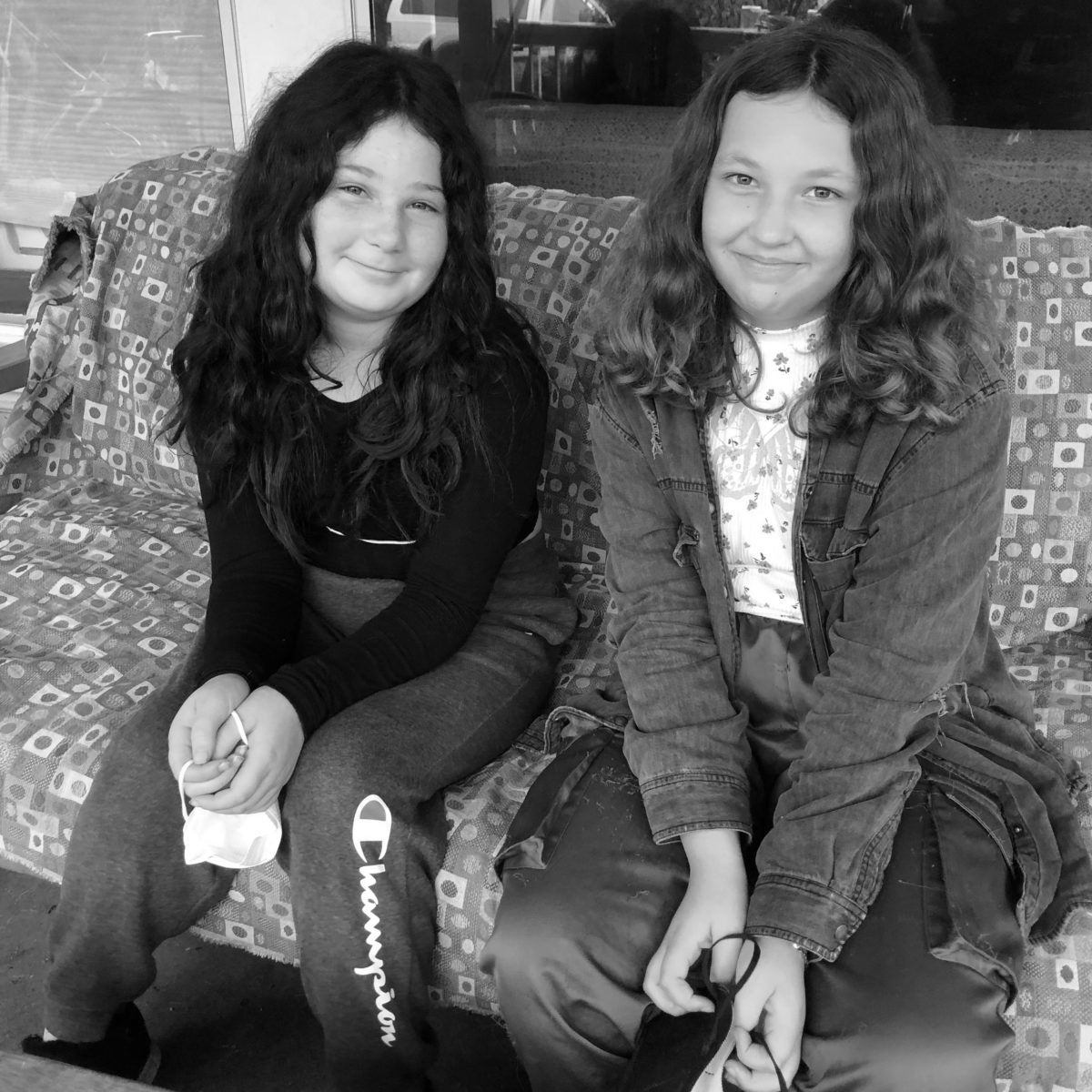
Sophie Wice-Budner (left) and Oona Fife (right) are fifth graders at Sunnyside Elementary School who have known each other since kindergarten; they’ve both lived in Sunnyside since they were babies. The past two years have been full of unexpected challenges for them: learning to navigate Zoom, Seesaw and other online platforms; months of not seeing their friends in real life; and having to wear masks everywhere they go. But like many kids across this country, they’ve shown patience and resilience. (And also a little frustration.)

What’s the biggest difference between school in-person and school on Zoom?

Sophie: [School in person] is way less frustrating.

Oona: Much, much less frustrating.

Sophie: On Zoom, it’s really hard to learn, because if you don’t have perfect internet, it’s glitchy. Even if it’s like only a little bit glitchy, it will just all of a sudden be really glitchy.

Oona: I think it was Seesaw that we were using. It did not work that well.

Sophie: I did not like Seesaw at all.

Oona: It’s much easier how we’re learning now—from a teacher telling us what to do instead of reading off something. 

Did you have a lot of empathy for your teachers?

Oona: It looked very hard; they looked stressed out.

Do you think you learned what you were supposed to learn in fourth grade?

Sophie: No.

Oona: No.

What do you think you missed?

Oona: A lot of stuff!

Sophie: We’re having to review math, like long division. We didn’t use the math packet because we weren’t in person.

Oona: We were supposed to use this specific math packet and algorithm, but we didn’t get to do it. But I would say we still learned enough because my teacher was just really good, in my opinion. 

Neither of you had used Zoom before the pandemic. How did you know to mute yourself and how to raise your hand? 

Sophie: We didn’t know anything at all about electronics. We just had to figure it out and try our best. There were some people that didn’t learn. 

Oona: Some people had their mics on when they’re, like, yelling to their mom about something. 

Sophie: It was really distracting.

Did you ever have the experience where you’re on Zoom and everyone’s trying to learn and someone’s little brother or sister would come on?

Sophie: Oh yeah, totally.

Oona: Rainer’s little brother, in our class, kept doing that.

What would they do?

Sophie: They would just run in and, like, scream half the time.

Oona: This kid in my class last year—his little brother would come in all the time while he was sitting on the couch in his living room. And he would just start dancing and going up the screen and just like, yeah, just with his face pressed to the camera. It was really funny.

So maybe you’re behind on long division and some other things. But is there anything you think you did learn last year because of the pandemic—not academically, but just about life?

 Oona: I learned how to keep in contact with my friends really good, but I think a little too much because it was distracting probably because we use, um, Google chat, which is on our Chromebooks that the school provided for everyone.

Sophie: I could only stay in contact with a few friends. So I learned—we learned—how to plan on our own, instead of having to get our parents to plan stuff and, like, go on bike rides and just hang out a lot.

What is challenging to learn when everyone’s masked?

Sophie: Our teacher is not a very loud person at all, so she has a microphone-thing that gets squeaky and annoying, but it helps a lot. And it’s just hard for everyone to hear each other and understand each other. And [the mask] hurts my ears with the straps—it’s really uncomfortable.

Oona: I’ve gotten very used to wearing masks. So I think it’s kind of just like wearing my clothes or something. I wear this one all the time because it’s safer for me to wear it at school since I’m not totally vaccinated yet. I just got my first shot a couple of days ago.

How did it go? Did you have any reactions?

Oona and Sophie (together): No.

You had to see everyone else get vaccinated first.

Oona: My brother and my parents are all vaccinated and my mom had a booster, so they’re all kind of good. It’s kind of annoying to see that my brother can have like sleepovers with his friends. He’s in seventh grade.

Sophie: I feel more free, Covid-wise, now that I’ve gotten my vaccine, like going into stores and stuff. 

At school, is it masked all the time, even during recess?

Sophie: Oh yeah.

Oona: We can take our masks off to eat but only like this [barely, quickly pulled down and then back up] if we’re eating inside. There’s an option to eat inside if it’s really rainy outside. Some kids can’t eat inside because the parents don’t want them to. My parents let me eat inside.

Sophie: At first my parents weren’t okay with me eating inside. And it’s really hard. They don’t have anything set up for people that have to eat outside. They didn’t even have sit-upons, so you’re not sitting on the wet ground.

Oona: Now we have sit-upons.

Sophie: Everyone had to stand up while they were eating and hold their umbrella in one hand. And not everyone had an umbrella.

Oona: Me and Sophie, actually, we have really huge umbrellas and one time we were sitting together and we’re like, how about we just sit on our umbrellas? So we just sat on our really huge umbrellas and ate our lunch together? 

It sounds like you both are very resourceful. Have you ever had a moment in all this where you just feel like you can’t do it anymore, where you’re at your pandemic limit? 

Oona and Sophie: YES!

What would you say to yourselves just as the pandemic was starting? Or what would you suggest to other kids in some far off land who have never gone through a pandemic before, where they are where you were two years ago? What would you say to them? 

Oona: I would tell them, literally: Don’t be too hopeful. And keep in contact with your friends.

Sophie: I would tell them to try and be optimistic but just like, don’t assume something’s going to be great because then you’ll be disappointed if it doesn’t happen. Like, nowadays, a lot of things get cancelled.

Oona: Don’t feel too hopeful. 

Sophie: I mean you can be a little hopeful. 

Oona: You can be optimistic, but don’t really expect it, because you’re going to be disappointed if it doesn’t happen. So just don’t over-hope, I guess.
Emergency Preparedness

November Preparedness Tips

On the FEMA preparedness page November is ‘winter weather preparedness.’ Hmm. It’s a broad term for what we all need to do to make it through the mostly rainy months here in the Pacific Northwest.

Even though my husband and I have lived here for over 9 years, it is very different from our preparedness efforts back in the Chicagoland area. In November, our neighborhood snow blower, which was stored in our garage, had been checked over and sent out for maintenance, if needed. In the early fall. 

We found our snow shovels and windshield scrapers and stored them in our cars. Our neighborhood street signs were re-read so that we knew when alternate street parking would take place so that the snow plows would come and clean our street. If we didn’t pay attention, our cars could be towed or worse – the snow plow would move around the cars that weren’t moved – often moving the mounds of snow in front of our driveway.

When we moved to Sunnyside we were shocked to find out that street cleaning was rare (or never) and that neighbors’ cars parked on the block never had to be moved. Never. Whaat? 

So, what does November preparedness look like in Sunnyside?

Here are some tips:

* Remove leaves not only from your sidewalk but from the street in front of your property, including under your cars. We have lots of pedestrians and bikers and we should make it safe for them to get to where they need to be. 

* Get a snow shovel and use it to remove the ice and snow from the sidewalk in front of your home. Clear the steps leading to your front door so that our mailperson/delivery people can safely navigate.

* Help clear the street drains so that the ice and snow can safely get to the sewers. Here is how to locate and clear street drains safely: https://www.portlandoregon.gov/transportation/article/319667 If you are reading the printed newsletter, you can google “Stormwater Drainage/Street Care/City of Portland, Oregon” and you will find tips there.

* Continue to bring foodstuffs to the Sunnyside Free Food Resources, located at SE 42nd and Taylor on the north side of the street, near our beloved chickens. Feed the chickens while you are there with the quarters you brought along just for that reason. And, while you are there, drop a book or three in the Little Free library. It’s a great community support spot.

Questions, tips, thoughts? Email me: [email protected]

Portland Committee on Community-Engaged Policing Recommends Changes to PPB Core Patrol Services

At the request of Mayor Wheeler, the Portland Committee on Community-Engaged Policing (PCCEP) conducted a study of the Portland Police Core Patrol Services, which is what the majority of the police force does (respond to emergency or non-emergency calls, conduct preliminary investigations, enforce traffic and criminal laws, etc.). PCCEP studied many hours of public testimony, working sessions, and community surveys in order to develop their recommendations for how Portland’s Core Patrol Services could be improved. PCCEP voted unanimously on their recommendations on May 25, 2021. 

Coordinating Committee of  the Portland Metro People’s Coalition recommendations are bold, but also practical.  They include:

1) Expand Portland Street Response to the entire city;

2) Increase the number of unarmed Public Safety Support Specialists who are trained in de-escalation and knowledgeable about services for people in crisis;

3) End racial profiling at traffic stops and begin the process of developing a new body of unarmed officers to handle most traffic enforcement; and

4) Develop restorative justice interventions for youth and increase community resources for violence intervention programs. 

These recommendations will improve public safety while freeing the police to spend their resources on addressing serious crime, such as gun violence. 

At a Work Session on July 27, 2021, the City Council chose not to act on any of these recommendations nor did they establish a timeline for when they will decide to act. It is now up to us, the community, to make our voices heard if we hope to see these important changes enacted. 

So far, Southeast Uplift and four neighborhood associations have endorsed these recommendations. If you would like to learn more about the PCCEP recommendations, please attend the November 11th Sunnyside NA meeting. Johanna Brenner from the Portland Metro People’s Coalition (which is supportive of PCCEP’s recommendations) will explain them in more depth. A summary of the PCCEP recommendations is available at (https://www.portlandoregon.gov/pccep/article/783958).

Sunnyside Neighborhood Community Cares (SNACC) Committee Updates

At the last SNACC meeting on Thurs. Oct. 18th, we discussed conducting a needs assessment of the shower program to gather feedback from the people who use the showers to learn what is working well and what isn’t. The shower program is also organizing another clothing drive to provide requested winter gear for the houseless community. The date and location to be determined. There wasn’t much to report on trash removal, other than that the same areas continue to be a challenge. There was some talk about investing in longer term solutions, which the group agreed was important to revisit. The committee will also finish the work needed to launch the “Get On The Sunnyside” communication plan. Some members then signed onto (zoomed over to?) the South Tabor Neighborhood Association meeting. Tremaine Clayton and Britt Urban shared information about the work they’ve been doing with Portland Street Response (PSR). This program will be expanding starting November 1st to include East Precinct, which covers Sunnyside east of Cesar Chavez Blvd. Next Mireaya Medina and Babatunde Azubuike from “Black and Beyond the Binary Collective” facilitated a conversation about how their organization could collaborate with neighborhood associations to reimagine community safety. We encourage anyone who is interested in these efforts to attend our next SNACC meeting on Thursday, Nov. 18th at 6:30 p.m. Meeting details will be posted on the SNA website the week of Nov. 15th.

Getting to Know Your Neighbors

Q&A with Amy Jones and Roger Robinson

Something unusual and delightful began popping up around the Sunnyside neighborhood as winter set in last year.

As COVID-19 continued its spread I began seeing a new contagion, one marked by joy and vibrant colors, spreading from tree to tree. On our evening walks, my partner and I began seeing it take hold on new streets. At first, we thought only trees were harbingers of it. And then we saw that the neighborhood Little Free Library was also susceptible.

Yarn bombing isn’t new but it is to our neighborhood. And it’s been a welcome surprise of color and joy during what’s been a monumentally challenging moment for Portland and our nation. This type of street art is referred to by many names: yarn or wool bombing, guerrilla knitting, urban knitting, and kniffiti. Whatever you chose to call it, it employs colourful displays of knitted or crocheted yarn or fibre rather than paint or chalk.

We became enamored with these mystery yarn artists. So I began asking around until one day I found out who they were.

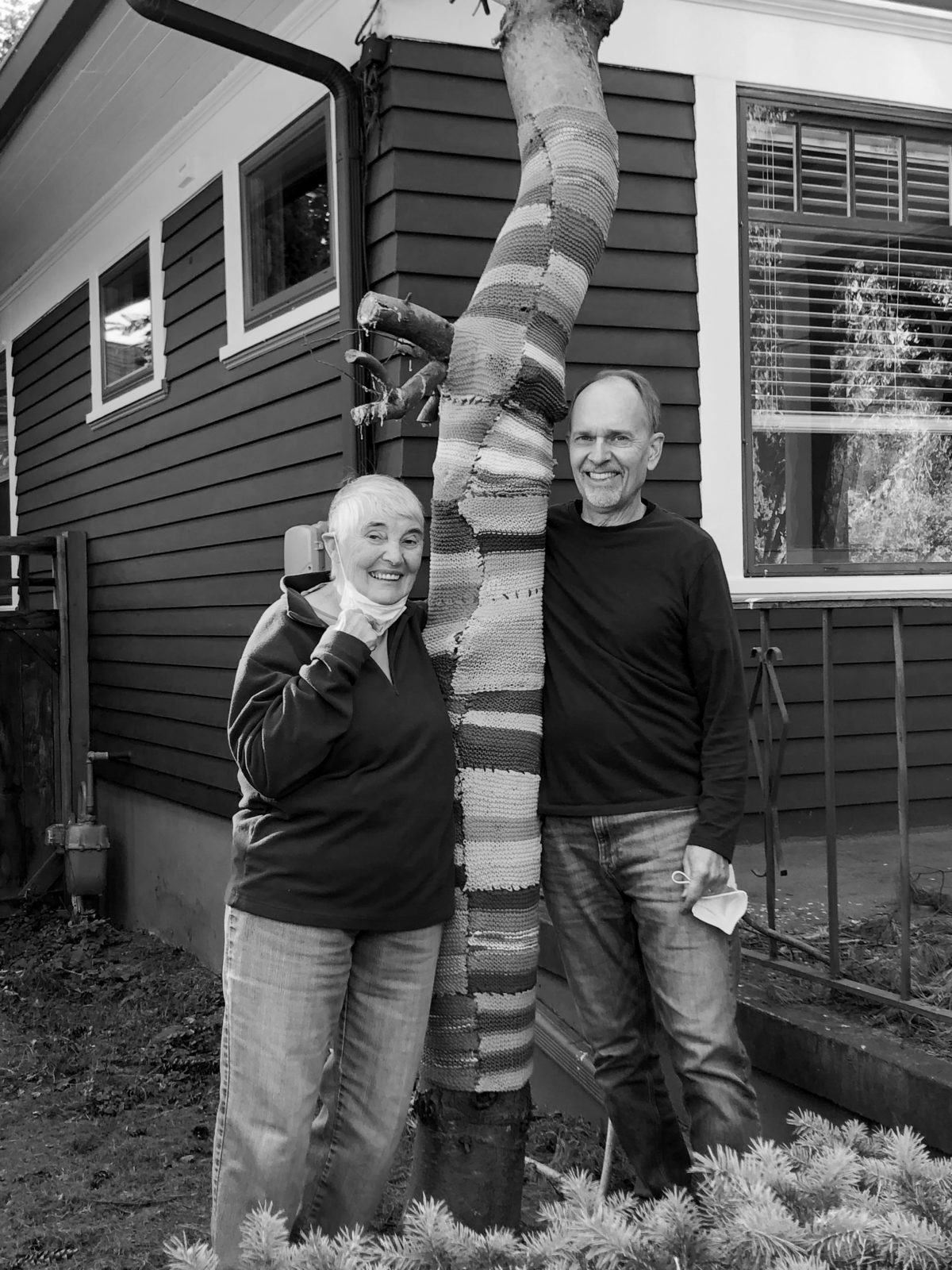
Spoiler alert: The yarn bomber was not Banksy. It was—and is—Amy Jones and Roger Robinson, neighbors of ours from down the street.

When did you begin the yarn bombing project, how did it start, what keeps you going, and what do you love about it most?

Roger Robinson: We began in October 2020. Amy mentioned to me that she didn’t know what to do with the knit squares she makes to keep her hands busy, which reminded me of an example of knit bombing I had seen in Cincinnati, Ohio a few years ago. I asked her to give some squares to me and said I’d show her how we could use them.

So knit bombing came to Sunnyside! She continues to knit them and I sew them together and we bomb them together. I enjoy seeing the excitement on the children’s faces when they see the bombs, and especially when they hug them.

Amy Jones: I keep doing it because I like to knit and to see my work enjoyed by others.

How long have you two lived in Sunnyside?

Amy: 22 years

Roger: 3 years

What’s your background?

Amy: I was a Head Start teacher in Pittsburgh and Portland. I was born in Bronxville, NY. I love to read, and earlier in life I loved bicycling and hiking.

Roger: My longest career has been as an architect. I’ve also been a database designer and business partner. I enjoy playing piano and painting, and I was born in Ft. Wayne, Indiana.

What was the hardest part of the pandemic for you?

Amy: Not being able to work with the kids at Glencoe Elementary School and not being able to travel.

Roger: Separation from friends and family.

What’s one thing you would like to see change about Sunnyside?

Roger: Eliminate the 100+ degree days.

Amy: I’m pretty pleased with Sunnyside.

What’s a fun fact about each of you?

Roger: I hitchhiked across the country when I was a teenager.

Amy: When my daughter Anne, also a Sunnysider, was 8 years old, she was bitten by Norman Rockwell’s dog.