Critic’s Corner: Review of Geekerella By Ashley Poston

Elle Wittimer loves Starfield, a sci-fi show that she grew up watching with her father. Years after his passing, she hears of a Starfield convention called ExcelsiCon with a Cosplay contest. The prize is an invitation to the ExcelsiCon Ball and a chance to meet Darien Freeman, the actor who plays the Federation Prince Carmindor in the reboot of Starfield. With savings from her job working at a food cart called the Magic Pumpkin and her dad’s old Carmindor costume, Elle is going to win, but her evil step-sisters are competing too. Can Elle win the Cosplay contest and survive her challenging life at home?

Darien Freeman loved going to ExcelsiCon. That was before he became famous, of course. Now it is just autographs, photos, and crazy fans. Playing the Federation Prince Carmindor is all he’s ever wanted to do but now people see him as just another dumb heartthrob. As ExcelsiCon nears, Darien feels more and more like a fake, until he meets a girl who proves him otherwise.

The first in a series of three books, this fractured fairytale with a geeky twist is based on the popular children’s book Cinderella.

I would give this book 4.6 stars out of 5
for the amazing plot, character development as well as the page-turning suspense that each chapter leaves you with.

Geekerella and the other books in the series can be found at the Sunnyside Environmental School library in the Young Adult section.

Getting to Know Your Neighbors

Q&A with Jesse Cornett

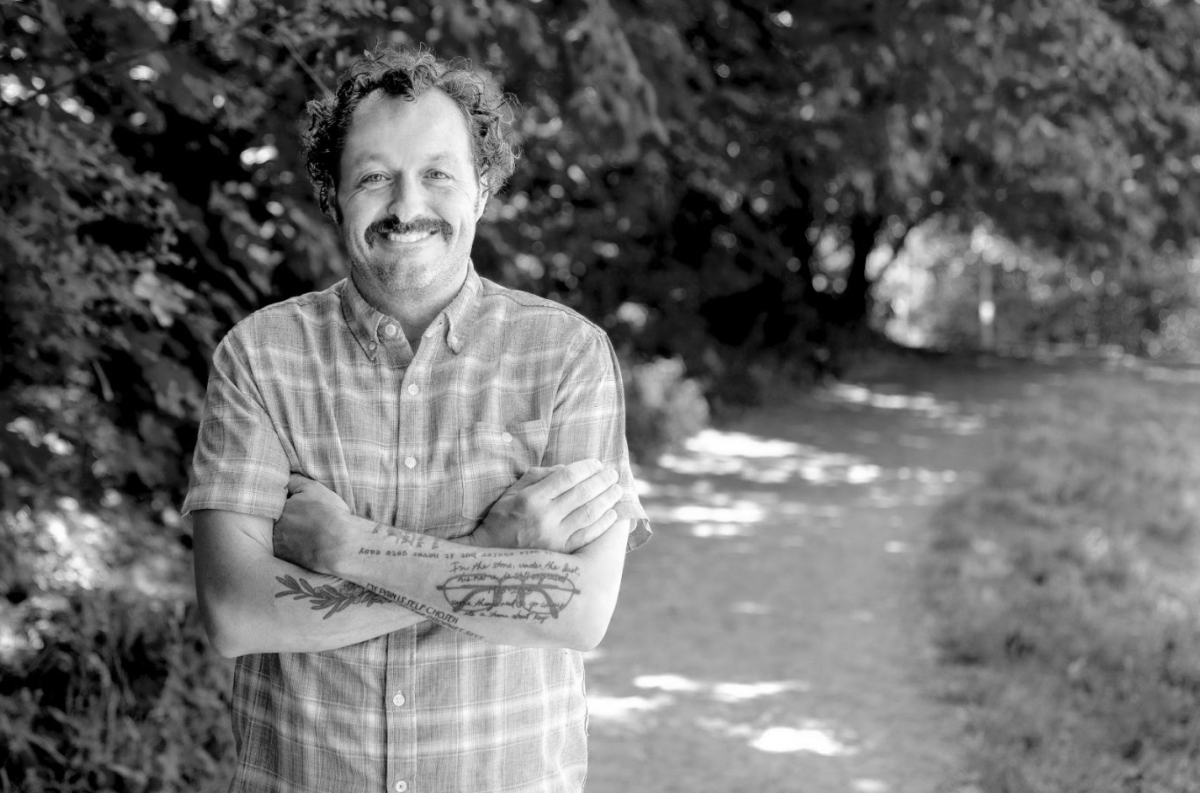
Jesse Cornett, the policy and advocacy director at Oregon Recovers, has lived in Portland for nearly 30 years. Much of that time he’s been involved in politics or policy-making. He was a veterans caseworker for Congressman Earl Blumenauer, the senior policy director for former Oregon Secretary of State Bill Bradbury and he worked on both of Bernie Sanders’ presidential campaigns. A former bar owner, he is now in recovery himself and is outspoken about the need for more detox and recovery beds in Portland. We spoke to Cornett about his campaign for City Council (District 3), his thoughts on the roll-back of Measure 110, and what changes he’d make to Sunnyside, if he could.

How long have you lived in Sunnyside? 

I started dating my partner, Andrea, in early 2022, and I’ve largely been here since. I’ve lived in a lot of Portland neighborhoods.

How did you get involved in recovery?

I taught at Portland State between 2013 and 2019. One of the classes I taught was “The Legislative Process.” In 2019 I had Oregon Recover’s then-program director in my class. In the 2021 legislative session, they were talking about a beer tax, and I went to this former student, Andrew, and asked if I could help. They said yes. Basically I went to them one day and said, “Hey, you gotta hire me as your lobbyist.” They were like “OK!”

So I lobbied on the beer tax, unsuccessfully. At the end of session, Andrew left to go to law school and asked me to step in as the policy and advocacy director; I agreed and did that for the rest of 2021. I left in 2022, but I remained on the board. At the end of 2023 they asked me to step in when Tony Morse left so he could focus on his campaign for City Council (District 4).   

You’ve run for City Council before, right?

I ran in 2010. I did not fare well, but I do like mentioning it. It was a last minute campaign. It was uninspired. I have been pretty open with my struggles with addiction and mental health. I think the reality was that I was in the depth of that at the time and had no business running. But, I did care about the issues.   

I also ran for State Senate in 2006, and I lost by 162 votes. You don’t forget those things. And both the people who I ran against (Dan Saltzman and Rod Monroe) have endorsed me this time, which I think is neat. 

Why are you running for City Council? 

I’ve been in and around the political process for two decades. As a staffer to elected officials I’ve managed and worked on high-level campaigns. I never thought I’d run again after I ran and lost in 2010. But, I worked for Bernie Sanders’ campaigns, and in the second campaign I did some really neat things—neat, hard things. I went to Canada with a bus full of diabetes patients to buy insulin at ten cents on the dollar.  I went to a child detention center and stood at the gates with Bernie and saw where we as a country are literally caging kids. I know those aren’t local issues—but they resonated for me. And when I got back to Portland, I walked everywhere and saw tents and the suffering on our streets. Even worse is the open hostility to people living outside. And it’s hard to not hurt.

So in June of last year I started thinking about this. I looked at who we had in positions of leadership—at the federal level it was Kevin McCarthy as Speaker of the House and in Portland Ted Wheeler was mayor. I just realized, “If these are the people leading our country and city, well, [expletive] it! I believe I can do remarkably better.” I come at this from a much more compassionate place. I think I have something to say. For me, housing and homelessness, addiction, public safety, and climate change are the big issues. I think, especially with climate change, we’re really not doing a good job of preparing for the realities of the damage that’s already been done, especially in terms of climate refugees.

I know Measure 110 was passed state-wide, but what do you make of the legislature’s decision to roll it back?

I didn’t support Measure 110—the support structures for those caught with drugs were not built out. Nor did I support recriminalization, because of the equity issue that I saw.

What Measure 110 did, as you know, is decriminalized the possession of small amounts of drugs. Simultaneously, it diverted funding to create a system to deal with the aftermath. The idea was that, we’re not putting people in jail, so let’s create other programs—a behavioral health resource network. Well, we stopped handing out citations prior to these programs being built up. We should have built programs first and then changed the penalties. The legislature didn’t seem to learn anything from that, because what they did was they recriminalized possession. And they are going to build an entirely new system to deal with the aftermath.

What do you mean “an entirely new system?”

Deflection. This fancy new diversion system [meant to divert people from the criminal justice system by steering drug users toward treatment, recovery services, housing and other services]—but it doesn’t exist. [Each county will design its own system.] The legislature gave Multnomah County $25 million and it’s expected to be in place by September.

Thirteen counties didn’t opt in. You don’t have to so in 13 counties you are not going to be offered deflection. You are just going to get a criminal charge, full stop. In the 23 counties that signed on to this law, there isn’t a requirement for consistent enforcement. So, if me and a 20 year old black man were high and smoking fentanyl in front of your house, a police officer can show up and can send me to treatment and the black man to jail. And I think it’s simply unacceptable.

What do you love about Sunnyside? 

The restaurants! I love Bluto’s. The walkability! I go into Safeway at least six times a week. I’ve gotten to know the workers there. The coffee shops! I’ve been going to Common Grounds more and more. It lacks pretense, which I like.

What is one thing you would change about Sunnyside, if you could?

Make it more affordable. I’m aware of how lucky I am that Andrea bought her place in 1999. Keeping it affordable would be good. 

What do you think of the Inner Eastside for All campaign that Portland Neighbors Welcome is putting forth?

There’s a delicate balance. I talked about climate refugees. That’s gonna worsen in the next 20-30 years, and we have to keep up with the growing demand. Those are going to be immigrants in a lot of cases. I don’t think that we should just focus on building more cheap housing on 122nd. I think there’s a vibrancy to mixed neighborhoods. I don’t like the concept of tearing down perfectly good buildings to put up new bigger ones. But there’s also a balance of keeping up with demand. We have to simultaneously be mindful of the desire of the historical neighbors, the threats of climate change, but also manage the population.

I’m also in favor of a land value tax on empty lots. You’ve got this city block that’s just sitting there vacant? It’s out there vacant for 60 years. OK, cool, you can continue to do that, and the value of that lot would be, let’s say, $10 million. So we’re going to assess your tax at the $10 million level. And if you’d like to develop the lot to keep up with your taxes, great. If you just want to pay the taxes, OK. It would incentivize development. If I were to promote something like that—I would say there should be a 5-year period (or maybe even 10) where there’s no tax assessed. So year 6, you start getting assessed. And maybe we ramp it up over those 5 years. 

Cat or dog?   

I think that’s an unfair question! Andrea has a dog; I love that dog and I love dogs. But, my answer is nuanced. More nights than adults should admit I’m watching stupid cat videos.

News from the President

Hi Sunnyside! How are you doing? As I write this, it is one of the first truly gorgeous days of spring (in March) and I find myself starting to dream of the dizzying array of colors and scents that April flowers will bring, the first fresh produce of spring at the farmer’s market, and cool evenings spent on the porch chatting with neighbors. Future me is a happier Sunnysider in April!

Onto the news…The SNA’s March meeting focused on the proposal from Portland: Neighbors Welcome that would add language to the Housing Bureau Strategic Plan (HBSP) for increased density in inner eastside neighborhoods. The HBSP guides zoning and development decisions and sets development priorities. An update is due this summer. The proposal, called Inner Eastside For All, would allow for what they call “four floors and corner stores” to be built anywhere between approximately SE 12th and SE 60th and SE Powell and NE Fremont. We had a nice turnout for the presentation and there were a lot of new faces, which I’m always happy to see! Opinions were varied. Many welcomed the effort to increase housing availability and hopefully make rent more affordable, but there were worries about how this development would actually occur. Would it be the small groups of people building community together through creating shared living spaces in small apartment buildings? Or would it be developers slowly buying up lots and leaving them vacant while they seek to put together large enough parcels to make it profitable? What would the effect be on longtime residents of our neighborhoods? How about the recent Residential Infill Project that already allows for the expansion of ADUs and small multiplexes? You can learn more about the proposal at https://portlandneighborswelcome.org/inner-eastside-for-all.

This summer we are planning on repainting the beloved Sunnyside Piazza at 33rd and Yamhill. The piazza is one of the oldest intersection art installations in Portland and it needs a refresh! We set up a Piazza Working Group to help manage and facilitate the project. If you are interested in helping out, please contact us at [email protected].

Finally, as mentioned below, our annual Board elections will be held on May 9th. I can say from personal experience how rewarding it is to be an active part of the SNA board. You get to meet new people from all over the neighborhood and hopefully make a small difference for all of Sunnyside! Please reach out if you are thinking of joining the Board and want to learn more. You can reach me directly at [email protected].

That’s it for now. At our April 11th Board meeting we will be hearing from the CEI Hub Task Force, which is building awareness around the dangers to all of Portland posed by the Critical Energy Infrastructure Hub, the bulk fuel storage facility between the Willamette and Hwy 30 in North Portland. See you there, in May for our annual elections, or out on the porch swing!

Upcoming Elections: Calling All Candidates

Want to become more involved and help your community? The Sunnyside Neighborhood Association, a volunteer organization, will hold elections at its May meeting. Nominations are open for five positions (of nine total), including President, Secretary and three General Board positions. The Board engages the community and sets the agenda for monthly Board and bi-monthly General meetings. You can find details on the duties of individual positions in the Bylaws section of the website at SunnysidePortland.org. If you are interested in being on the Board or know someone who is, please contact [email protected]. Remember, Portland is what we make it! 

Getting to Know Your Neighbors

Q&A with Anis Mogjani

If you’ve ever walked by the Sunnyside playground and seen a crowd gathered in front of one of the buildings lining Yamhill, you might have wandered into “Poems at Sunset out a Window,” an impromptu event hosted by Anis Mojgani, the Poet Laureate of Oregon. Anis is also a visual artist, currently finishing the art for his forthcoming children’s book Lifespans of a Rock. He has been Poet Laureate since 2020, a gig that takes him from Medford to Enterprise to nurture poetry in our state.

Raised in New Orleans, Anis first moved to Portland in 2004. After a brief stint in Austin from 2011-2015, he came back because, as he puts it, Portland held “the largest contingent of people who I love, and people who love me.” For years he has lived in a house off Hawthorne called “The Pointy House” with a group of friends, and he runs into a friend wherever he goes in Sunnyside. We sat down at Stumptown on Belmont to talk poetry and Portland.

When did you get your studio on Yamhill?

Anis: I got that space in February of ‘22. At that time, I had an office in conjunction with the Poet Laureate appointment in Southwest over at the shipyard, which was really rad, but it wasn’t conducive to visual stuff, and I really wanted someplace close to the house.

My friend Lilith has a ceramic studio in that building [on Yamhill]. It’s basically three buildings connected, and she and somebody else were in one of the other buildings. The building that my studio is in was completely empty at the time. Kevin, the guy who had just bought it, was planning at that time to either knock it down or gut it. And so, I was like, ‘Hey, Kevin, can I use one of these empty rooms?’ And he’s like, ‘Here are the keys, I’ll probably have to kick you out in six months to gut it.’ But his plans changed, and so, after six, eight, 10 months, I just started paying rent, and other folks moved into the building.

And you do events there.

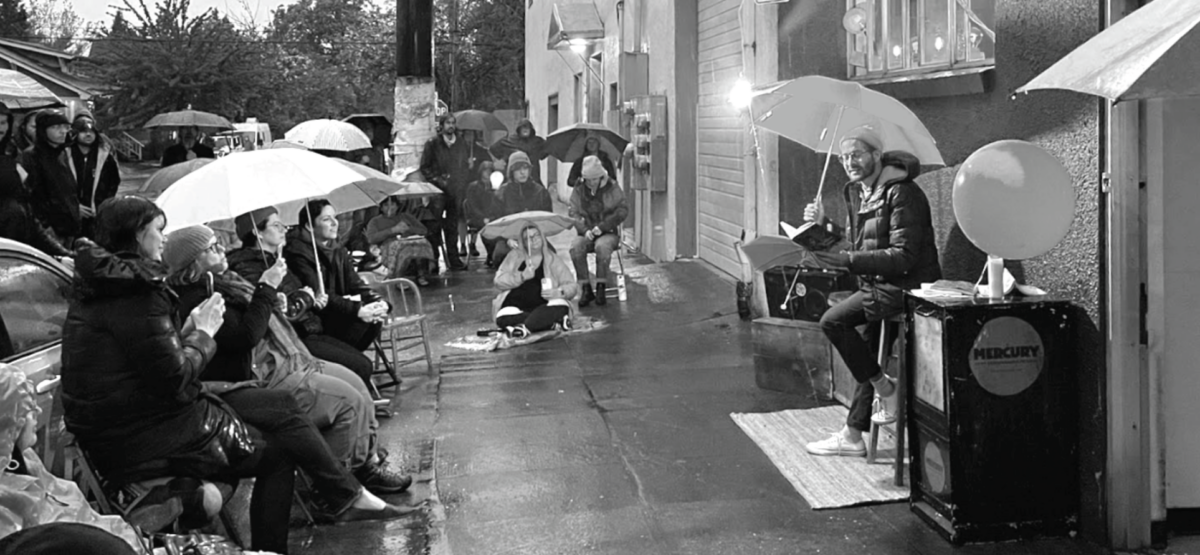
Anis: I started doing these readings where I just read poems out of the window. We started doing that in March of ‘22, and it has always been very loose—a little intentional looseness. I’ll make a poster to put up on my Instagram one to three days before the night of the reading. It’s pretty much always been at sunset, and most of them have  been on Fridays. Folks just show up.

This past year when we did it, there were 250 to 300 folks just sitting in the street. Cars can’t easily drive down the street because it’s between the back fence of Sunnyside [Environmental School] and the building. It’s people sitting there, standing, and we hang out for an hour, and then we go off into the night and that’s that. The first one came about as a result of my friend, Jenn coming by to hang out, and we ended up just hanging out via the window, just me in the window, and her on the street, and us talking. And it was just so nice. It felt very neighborhoody, and we were like, ‘This was super fun. We should do this with more people.’

It wasn’t anything that was like, right, let’s find a space and let’s do this thing. It was just sort of like, all right, hey, we did this thing, and this was fun, and folks enjoyed it, so we kept doing it. It’s something that started revealing its intent and purpose, which felt really in line with how to explore and expand what we all might envision as being a show, a performance. What’s the relationship between artists and audiences? What are the ways in which too much of our day-to-day world is one that requires us to engage in a transaction? What are the ways to build a space that doesn’t ask someone anything, just allows them to just be with others?

Cities are always changing, and I think whoever is sitting at the top of the ladder in cities, is usually moving those cities towards things that probably the majority of the people in the city aren’t asking for. It’s felt in these recent years that Portland is very much in a place like that. And so, the window I think, allows me as an individual to create something that leans toward a city that I want, and the city that I want to see. And hopefully by way of that it also invites other people to think about what a city means.

I think often we think about cities as being something that is constructed and legislated, and that’s part of it. But, cities are also a person saying poems out of a window, or putting a mural on this wall, or organizing a food drive, or setting up a food pantry, or whatever it might be. And so, what are the ways that any of us might be called to think, ‘I’ll build this little part of the city’? The poetry window allows me to engage with the political activism that is important to me but also fits with me.

Can you tell me about the Poet Laureate program?

Anis: I’m in the last chunk of my second term. The terms are generally two years with the possibility of being renewed for a second term. I started on May 4th of 2020. I’ll conclude in May of this year. In the fall, [the organizers] open it up to the Oregon-wide community to nominate someone who they feel would be good in the role. Then they contact nominees and ask them to send applications if they’re interested. They apply, and a committee of artists and organizations go through a committee selection process. They make a selection, send it to the governor, and the governor says yes (or no). The only really tangible tactile responsibility is to do 20 public engagements over the course of those two years. It comes with a $15,000 stipend each year, and each year there’s $10,000 allotted for budgetary expenses for travel and whatnot.

For me, it’s about having a position, having a support system to introduce, deliver, foster, allow, and support poetry to and for the people of Oregon, however that might look.

What do you hope to see in Portland in the coming year or years?

Anis: Oh, man. What I would love to see for Portland is a city that really seeks to take care of all of its residents. Yes, of course, the many folks that are living without anything, and also just all of us. I think that’s the thing that’s been really frustrating over these last several years. It almost feels as if the city doesn’t know how to take care of anyone.

In the last three years it feels like the city’s like, ‘What does the Portland Business Alliance want? Be quiet, everyone else. They’re the people who we’ve got to save first.’ I want to see steps towards a lot of inclusivity for the people who live here. And also just to see action taken. It’s my understanding that the level of money and resources specifically devoted towards houselessness services has just disappeared at the end of the year, and nothing has happened. I want action. Even if it’s like, ah, this reveals itself to not have been the right decision. It’s like, just try something.

I also think about different plans and ideas that have surfaced over the years I’ve been in Portland that just haven’t come to fruition. One idea was basically a very green, lush, shiny bike highway that was envisioned for connecting both sides of the river. Seeing something like that would be amazing. What are the ways in which development in the city can happen that serves the city not just five people’s bank accounts?

It’s a city that is, I think, rich in creativity, rich in the arts, rich in cultural events, and cultural affairs. What are the ways that we might capitalize on this, for lack of a better word, and support these things?

To learn about the next Poems at Sunset out a Window, follow Anis on Instagram at @Thepianofarm

Lydia Kiesling is a writer who lives in Sunnyside. Her latest novel, Mobility, came out in August.