News From Sunnyside Environmental School

SES teachers and staff work at Sunnyside because they believe in the empowerment of place-based learning, safeguarding the environment, and social justice. During the summer, many of them are out in the world—learning, volunteering, fighting for causes, and building their knowledge and skills. In this issue as well as next month we spotlight some of the things they do when they’re on summer break.

Tara Branham, SES Middle School math teacher spends her summers volunteering in Maui as the volunteer coordinator for the Hawai’i Wildlife Fund’s sea turtle nesting project. This organization monitors beaches for nesting activity and then patrols the beaches once nesting begins to ensure the turtles are safe and can hatch in peace. She also pitches in on beach clean ups and marine debris education for SHARKastics. If that wasn’t enough she also volunteers at Maui Nui Seabird Recovery Project where she helps monitor the ground-nesting Wedge-tail Shearwater burrows. SES alumni often join her to volunteer or intern.

SES teachers’ dedication to the environment, to the topics they teach, and to their students is unsurmounted.

Upcoming Important Dates:

• 8/20–8/25 Teachers are back on campus

• 8/26 First day of school for students

Please remember:

• Once school is back in session the park will be closed to the public during school hours 

• Keep your dog on leash

• Slow your roll when driving near the school.

Have questions about SES? Email [email protected] and maybe I’ll answer them in a future column!

Sunnyside Tails: Baby Kitty

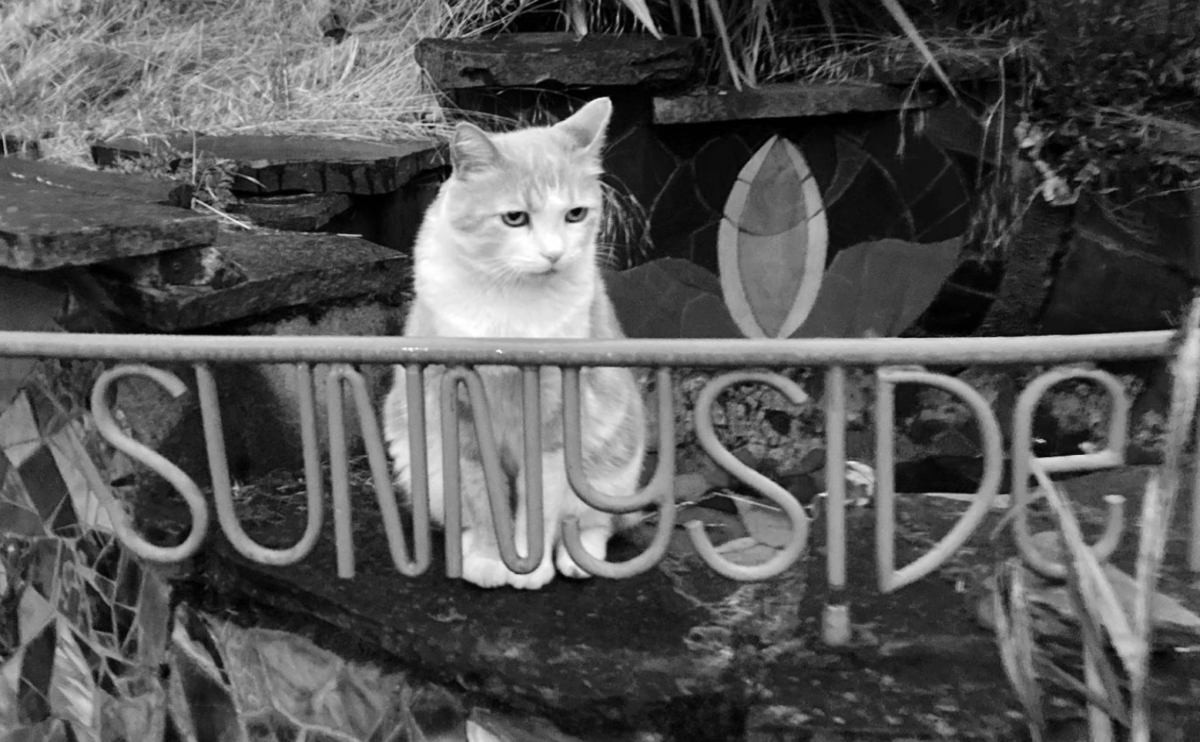
Sunnyside Tails is a new column introducing you to some of the best cats and dogs of the neighborhood. We begin with the official mascot of our Cats of Sunnyside community cat walk: Baby Kitty! 

Safety note: Having a sense of a cat’s current mood is always wise. We recommend watching its tail movement and offering a hand to sniff first.

Known through neighborhood lore as Baby Kitty, or BK for short, this ginger and white cat is easy to find and has become a Sunnyside institution. BK lives at the corner of the Sunnyside Piazza at Yamhill and 33rd at the house with a wreath composed of baby doll limbs on the door. But, that wasn’t always the case….Legend has it that our creamsicle compatriot once lived down the street. He loved spending time at his current residence so much that he made it his and now has indoor/outdoor access to the house. Recently, his humans added a BK access door and a little step on their side fence.

Over the years, Baby Kitty has evolved from a somewhat shy wallflower who would be taunted by his feline neighbor, Hugo, to a proud and gregarious ginger. He and Hugo now have a relatively healthy friendship. BK loves to come down and greet passersby, roll around in the dirt, and be a baby in the sunshine. Next time you’re in the neighborhood, be sure to show Baby Kitty some love!

If you’re interested in joining a future cat walk or would like to nominate your pet for a future Sunnyside Tail feature, follow us on Instagram at @cats_of_sunnyside for updates or email [email protected]  (There will also be flyers posted throughout the neighborhood.)

Wild At Heart II

Join us on June 25th from 6–10 p.m. at Foxtrot (3244 SE Belmont St.) for Wild Heart II, the second annual fundraiser and 5-year anniversary celebration for Sunnyside Shower Project, a volunteer-powered mutual aid organization serving unhoused and unstably housed neighbors in Southeast Portland.

For the past five years, SSP has provided free showers, hygiene supplies, clothing, laundry support, survival gear, snacks, and community care rooted in dignity and harm reduction. In 2025 alone, SSP provided more than 1,250 showers and supported nearly 2,000 visits, all powered by one staff member and over 80 volunteers.

Wild Heart II is a community celebration to keep this vital program running. Expect music from Portland rock-and-roll DJ Wax Casket, food, drinks, raffle prizes, silent auction items, and a whole lot of people who believe in this community and the power of collective action.

Raffle and auction items include stays at Jupiter NEXT and Adrift Hotel, tickets to see Sleater-Kinney and Liz Phair, a haircut by GoodbyeHorseGirl, Freeland Spirits distillery tours and tastings, Skyhook Bouldering passes, gift cards to Bangkok Belly and Bread and Ink Cafe, and prizes from the North American Bigfoot Center alongside donations from some of Portland’s most beloved community spaces and creators.

$10 suggested donation. No one turned away for lack of funds. Visit sunnysideshowerproject.org/wildheart2 for more info.

News From Sunnyside Environmental School (SES)

The school year is wrapping up this week. The last day of school is June 5th instead of June 12th, due to the sudden PPS budget shortfall this Spring. The final week of school will be filled with finalizing projects, cleaning desks and lockers, 5th and 8th grade promotions, and end-of-year celebrations. Starting June 6th, the park and playground will be open to the public until school is back in session at the end of summer. Feel free to grab a snack from the garden while you are there—at least up until August 21st. Don’t forget to check out the outdoor learning space that was designed by our amazing middle school students! It’s a great spot to sit and eat your garden snack.

Get Tech Out of PPS

A new SES group is forming to petition PPS to restrict the adoption of AI tools and generative AI. PPS is spending millions of dollars on technological adoptions, while data shows that analog learning has higher success rates. This is especially concerning when the PPS school district is in the middle of a $54 million budget shortfall and is in the process of cutting teacher positions, closing schools, and raising class sizes. Many advocates of public education feel that PPS is spending money in the wrong areas. If you are interested in supporting this effort you can send an email to [email protected].

Storyline

Did you know that SES uses Storyline methodology as part of their English Language Arts curriculum. In great part due to the hard work of the SES Site Council, grades K-5 used Storyline this year. Storyline begins with an anchoring phenomenon such as, in the case of SES 4th graders last year, learning about Celilo Falls through a visit from Linda Meanus, a Warm Springs elder. Her stories sparked a line of questions from the students that later directed their research. The unit culminated in the 4th grade classes visiting the Senate Appropriations Committee and presenting cases in defense of Celilo Falls at the committee meeting. This type of education is what is so special about SES. Learning that is based in real, and current topics that are student-led stretch beyond the classroom and enhance student engagement.

Drive Safely

Please remember to drive safely and slowly around the school. This is especially important at the beginning and end of the school day as there are many students who walk and bike to school. There have been some close calls in the recent weeks. Be vigilant, drive slowly and follow the rules. Please pay attention to the crossing guards and the parking signs. Last month volunteers painted the curbs around the school yellow to promote traffic safety. Since many children play at the school during the summer months it’s always best practice to slow down in school zones and be vigilant when driving through crosswalks. 

Have questions about SES? Email [email protected] and maybe I’ll answer them in a future column!

Tech Tip: Persuasive Design and Why It’s So Sinister

Something major happened in Silicon Valley in 2007 that completely changed our relationship to technology, though the general public was told nothing about it. That year, a secretive science called Persuasive Design Technology was born, and it’s the primary reason that it’s been such a struggle for parents to regulate screen time for the last 20 years. If screen time is difficult in your house, Persuasive Design is to blame.

Persuasive Design Technology was invented by a behavioral scientist at Stanford University named BJ Fogg. Fogg spent 10 years exploring ways to take everything he knew about behavioral science and combine it with technology to create apps that persuade and motivate us. He described his work by saying, “I design systems to influence human behavior.”

By 2007, Fogg had perfected this new science and founded a class at Stanford called the Persuasive Design Technology Lab. He taught 75 of Stanford’s best young tech designers the science of how to motivate human behavior and then asked them to create apps using his techniques. (Instagram originated as one student’s homework assignment.) Just ten weeks after this Persuasive Design Technology class ended, the apps these students designed had amassed 16 million users and taken in $1 million. Fogg quickly became known as “The Millionaire Maker.” The tech industry immediately hired these designers, asking them to add Persuasive Design to as many of their products as they could.

Persuasive Design Technology—such as loot boxes in gaming, Youtube’s autoplay, notifications, and the ability to scroll infinitely—works by lighting up the reward system in our brain. This system evolved to help us survive by rewarding us with the neurotransmitter dopamine whenever we engage in survival behavior, like eating, seeking the company of others, and sex. We often hear dopamine referred to as a “pleasure chemical,” but it’s much more accurate to think of dopamine as a “motivation chemical.” It’s responsible for our feelings of wanting, craving, and seeking. The higher an activity raises our dopamine, the more we crave it, and the more motivated we are to do it.

However, because our brains evolved in a Paleolithic environment of scarcity, our reward system can glitch when confronted by modern activities and substances. Many of these (alcohol, nicotine, opioid drugs, and slot machine gambling) raise our dopamine much higher than our brains can cope with. These high dopamine activities can hijack our reward system, causing us to crave, seek, and repeat behaviors that aren’t survival based.

What Fogg perfected in the 10 years he spent developing Persuasive Design was how to make technology that significantly raises our dopamine levels. Many of the apps we now use raise our dopamine as high as addictive drugs. A handful of tech industry insiders, including several of Fogg’s former students, have come forward to say they regret adding Persuasive Design to the technology we use. Tim Kendall, the former head of monetization at Facebook, testified before Congress in 2020 saying, “We [Facebook] didn’t just create something useful and fun. We took a page from Big Tobacco, working to make our offering addictive at the outset.” He went on to say that their intent was to make Facebook as addictive as cigarettes. Today, some of the tech products with the highest levels of Persuasive Design are video games, social media, and YouTube—the screen activities our kids use the most. The parents of Gen Z and Gen Alpha kids grew up using technology that was a neutral tool. The technology we are buying for our kids today is anything but—it’s chock full of addictive behavioral design. We have unwittingly become the first generation of parents to have to navigate this shift.

Persuasive Design is the missing piece of the puzzle when we’re wondering WHY it’s so hard to set limits on tech, and why it’s so hard for our kids to self-regulate. It’s why we remember being able to self-regulate our own gaming when we were young, but can’t understand why our kids struggle with it. Tech companies are getting better at Persuasive Design every year, hiring psychologists, behavioral scientists, and neuroscientists to ensure their apps raise our dopamine as high as possible. As one of the whistleblowers from BJ Fogg’s class now says, “There are 1000 people on the other side of the screen whose job it is to break down the self-regulation you have.”

Learning about Persuasive Design is one of the best things families can do to make screen time easier to manage. Great resources for parents are the book Better Than Real Life by Richard Freed and the documentary The Social Dilemma on Netflix. There’s a brand new book that explains Persuasive Design to kids ages 8-12 called The Amazing Generation by Jonathan Haidt and Catherine Price. We can also remove some of the Persuasive Design from the tech products our kids are using. Check out my website mindful-media.net to find my printouts How To Spot Persuasive Design and “Removing Persuasive Design from Technology.